The Housing Must Close Without Forcing the Assembly
For a paired enclosure, the functional result is created by both halves together. Perimeter edges must meet consistently; holes must remain aligned; internal supports must not press the motor, wiring or switch out of position. A dimensional report on one loose shell cannot confirm all of these relationships.
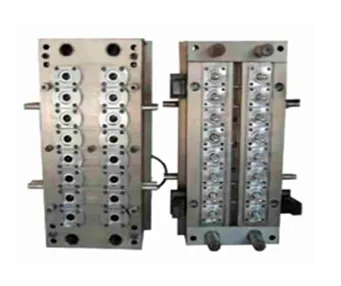
Our review therefore begins with the housing set and its internal layout. The customer identifies the fastening scheme and features that control final fit. Trial shells can then be closed around supplied hardware, approved samples or checking fixtures. This assembly-led approach gives the mould team clearer priorities.
Mould Decisions Specific to a Long, Deep Power Tool Shell
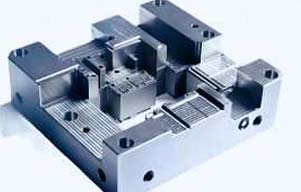
The body-to-handle geometry creates a longer and less uniform flow path than a shallow electronics cover. Material must reach narrow and distant sections without leaving a short shot or an obvious weld line in a stressed area. The gate concept is reviewed against filling balance, gate vestige and the exterior surface—not selected only for convenient trimming.
Cooling also needs to follow the changing section depth. Uneven heat removal can pull the two housing halves away from their intended profile and create an inconsistent joint line. Where deep steel areas limit conventional cooling access, the mould layout and process window need extra attention during trials.
The curved grip, internal walls and bosses also require suitable draft and stable ejection. Ejector marks are kept away from specified cosmetic or mating areas where the design allows.
Ribs and Fastening Towers: Strength Without Heavy Sink
Internal ribs help the shell resist flexing, while screw bosses transfer clamp load when the enclosure is closed. These features must be strong enough for assembly but proportioned so that heavy material concentrations do not print through as sink marks on the visible surface.
Tooling review focuses on rib-to-wall transitions, boss support and local wall build-up. The drawing should also define the screw type and any repeated-assembly requirement because a one-time factory fastening point may differ from a service-access location.
ABS Selection for the Actual Operating Environment
ABS offers a useful combination of impact performance, surface quality, dimensional stability and processing economy, but “ABS” alone is not a complete specification. The buyer should identify any impact target, flame requirement, operating temperature, UV exposure, chemical contact, named resin or documentation requirement before sampling.
Matching the Customer's Product Colour
Housing colour can be developed from a RAL or Pantone reference, or preferably from a physical sample. Because resin, texture, gloss and wall thickness affect appearance, approval is made on moulded pieces. The accepted sample and recorded resin/masterbatch details then become the repeat-production reference.
A Tooling Package Procurement Can Evaluate
European sourcing teams often compare more than a mould price. Our quotation can separate tooling and part costs and state the proposed cavity arrangement, mould steel, tool life, sampling scope and ownership. Buyer requirements for standard components, connectors, lifting points, nameplates, spare inserts or export preparation can be reviewed before design release.
The production forecast matters. Cavity count, runner choice and automation level should match the expected demand and part geometry. This avoids building an unnecessarily expensive tool for modest orders or a tool that cannot support the planned output.
Release from T1 Samples to Batch Production
The first mould trial establishes filling and release; it is not automatic production approval. T1 parts are reviewed for flash, sink, weld lines, warpage, gate condition and ejection. Key interfaces are measured, and paired shells are checked together when mating information is available.
Findings lead to process adjustment, local tool correction or an agreed design change. Once samples meet the defined appearance, colour, dimensional and fit requirements, an approved reference is established. Production inspection then concentrates on the enclosure profile, fastening positions, joint line and critical clearances.
One Supplier for the Mould and Finished Housings
YS Rapid coordinates DFM, mould manufacture, trials, colour approval, injection moulding and inspection through one project team. Our custom plastic injection moulding service supports power tools and industrial products requiring purpose-built enclosures. Related CNC, sheet-metal, silicone or moulded parts can also be coordinated.
Request a Power Tool Housing Moulding Quote
Send YS Rapid the 3D CAD model, dimensioned drawing, ABS grade, colour reference, current order quantity and annual forecast. Please also identify cosmetic faces, critical assembly features, screw specifications and any supplied mating parts.
We will review the enclosure as a production assembly and prepare a proposal for plastic injection mould tooling and ongoing ABS injection moulding. Contact us when you need a custom mould manufacturer capable of supplying both the tool and repeat batches of finished power tool housings.
 EN
 jp
 ko
 fr
 de
 es
 it
 pt
 tr
 ar
 iw