When Does a Low-Volume Injection Mold Make Sense?
Tooling should be selected around the forecast, part geometry, resin, appearance requirements, and expected mold life. The most expensive mold does not automatically create the best business result.
For this program, the projected quantity was well suited to a low-volume injection mold. Compared with tooling intended for large-scale production, the selected solution reduced the customer’s upfront investment and shortened the path to molded parts. At the same time, the steel tool provided the repeatability needed for ongoing production orders.
The part design and order pattern were reviewed before the tooling plan was confirmed. If demand increases substantially, the production strategy can be reassessed.
DFM for Custom PC Enclosure Injection Molding
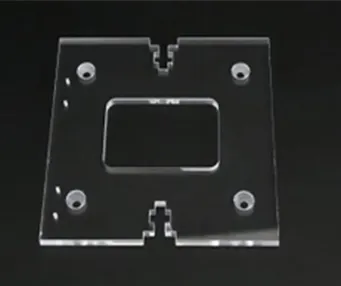
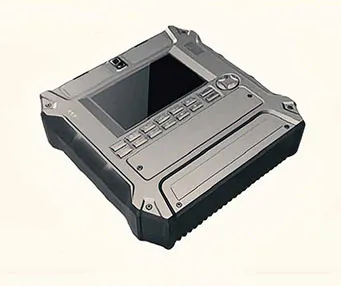
The enclosure contains several features that matter during injection molding. Its large central opening is surrounded by relatively broad wall sections. The lower face includes multiple circular openings and smaller indicator holes, while the sides include slots and mating features. The curved outer profile is also a visible surface.
During DFM, these areas are evaluated together rather than as isolated details:
Wall thickness and transitions are reviewed to reduce sink, distortion, and uneven cooling.
Draft angles are checked so the PC housing can release without drag marks or damage.
Gate position is considered in relation to filling, weld lines, appearance, and trimming.
The large window and smaller through-holes are reviewed for stable shutoffs and feature definition.
Side slots, clips, or undercuts are checked to determine whether sliders or other mold actions are required.
Ejection locations are planned away from important appearance and assembly surfaces.
Mating edges and internal locating features are reviewed for fit with the remaining product components.
PC offers useful strength and impact resistance, but its molding process must be controlled. Material drying, melt conditions, mold temperature, filling, and cooling all influence appearance and dimensional consistency.
From First Mold Trials to Repeat Low-Volume Production
A prototype injection mold may be used mainly to validate a design or produce initial samples. This project needed the tool to support first articles and repeat orders at approximately 5,000 sets per year. It was therefore planned as a low-volume injection mold for ongoing manufacturing—not as disposable sample tooling.
The first trial evaluated filling and reliable release. Samples were checked for short shots, flash, sink, weld lines, deformation, gate condition, and visible ejection marks. Critical openings and mating areas were also inspected against assembly requirements.
If a trial identified an issue, the response could involve process adjustment or a targeted tool correction. This validation step helped establish an approved part before repeat molding began.
Cost Control Without Treating the Tool as Disposable
The goal of low-volume tooling is not the cheapest possible mold. It is to remove unnecessary investment while retaining what is needed for stable parts. Here, cost control came from matching the steel, mold structure, and validation plan to annual demand.
This gives product teams several advantages:
Lower initial tooling investment than a high-volume production mold
Injection-molded PC parts instead of higher-cost prototype parts for every order
A repeatable process for scheduled low-volume production
Opportunity to validate market demand before committing to larger tooling investment
One supplier responsible for DFM, mold manufacture, trial molding, and part production
The result is a more balanced commercial decision: the customer receives a real injection molding solution without paying in advance for production capacity that may not be needed.
Low-Volume Plastic Injection Molding Services from YS Rapid
YS Rapid provides low-volume injection molds, prototype tooling, bridge tooling, and custom injection molding services. We can support plastic enclosure projects from manufacturability review through mold manufacture, sampling, corrections, inspection, and repeat production.
For a tooling review, send us your 3D model, available 2D drawings, resin requirement, expected order quantity, annual forecast, cosmetic specifications, and assembly information. We will review the geometry and recommend a mold strategy based on the part and forecast rather than automatically quoting a high-volume tool.
If your product requires hundreds or several thousand molded parts per year, a low-volume injection mold may provide the right balance between tooling cost, part quality, and production flexibility.
 EN
 jp
 ko
 fr
 de
 es
 it
 pt
 tr
 ar
 iw