Design details that matter when the covers meet
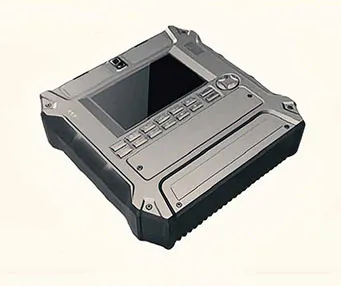
The lower housing has a rounded-square outline, a deep wall, internal reinforcing ribs and fixing points. Openings along one side provide additional access or ventilation, depending on the final product layout. The separate upper cover has two groups of narrow slots and mounting features near its edges. Its visible face must look clean, while its underside must align with the lower housing.
For this type of two-piece enclosure, the most useful DFM questions go beyond whether each part can be cast. Will the bosses and fixing features align? Will the cover sit evenly around the perimeter? Are the slots open and visually consistent? Could finishing material build up on a mating edge? Answering these questions on the assembled set helps prevent an attractive individual part from becoming a poor-fitting product.
Making 50 sets with vacuum casting
The production route starts with reviewed 3D models and carefully finished master patterns for both covers. Silicone moulds reproduce their geometry, and a rigid ABS-like casting resin forms the pilot parts. A 50-set order means 100 individual plastic pieces, so the mould plan should allow for wear, replacement moulds where needed and consistent appearance across the batch.
Vacuum casting is well suited to a market pilot that needs more than a handful of display models but is still open to design changes. It gives a product development or industrial design team physical units to assemble, handle and present. Testing that depends on the exact mechanical, thermal or regulatory properties of production ABS still requires the specified production material and an appropriate validation plan.
Achieving the flat white finish
The requested appearance calls for surface preparation as well as paint. The master patterns can be refined and lightly blasted where appropriate to establish an even base texture. Cast parts can then be trimmed and sanded before a smooth, flat white coating is applied. The aim is a uniform exterior across the upper and lower covers, with no distracting tool marks, visible casting defects or inconsistent sheen.
The slotted cover needs particular attention. Its narrow openings should remain clear after casting and painting, and the perimeter should be checked again after coating. A painted sample gives the customer a practical reference for white tone, sheen and acceptable surface quality before the full batch is finished. Assembly checks should also be made on finished parts, because coating thickness can affect a close-fitting joint.
Support beyond the two plastic covers
YS Rapid can coordinate the work around an enclosure project: DFM review, master patterns, vacuum casting, CNC-machined components, surface finishing and trial assembly. For products that need branding or control markings, screen printing and laser marking can also be planned around the chosen material and finish. Those operations are available services; they are not required for the plain white covers in this project.
Market feedback may lead to a revised pilot run or to injection mould tooling for ABS production. At that transition, the enclosure should be reviewed again for injection moulding requirements, including draft, wall thickness, gate position, material grade and the final cosmetic specification. The pilot helps the team decide what to change; it does not replace that production DFM step.
Request a quote for a small appliance housing pilot
Send the 3D files for both covers, the quantity per design, assembly drawings or mating components, the intended use of the pilot units and a white colour or finish reference. If the final enclosure must meet a specific heat, flame or electrical requirement, include that requirement as well. YS Rapid can then review the geometry, finish and proposed vacuum casting plan before quoting.
 EN
 jp
 ko
 fr
 de
 es
 it
 pt
 tr
 ar
 iw