What the Buyer Needed
One supplier to coordinate several related brass part numbers
Fewer setups for components combining round and off-axis features
Controlled concentricity between bores, outside diameters and threads
Stable thread fit and feature position across 1,000 complete sets
Set-based inspection and packing to simplify incoming assembly
Three Representative Brass Components
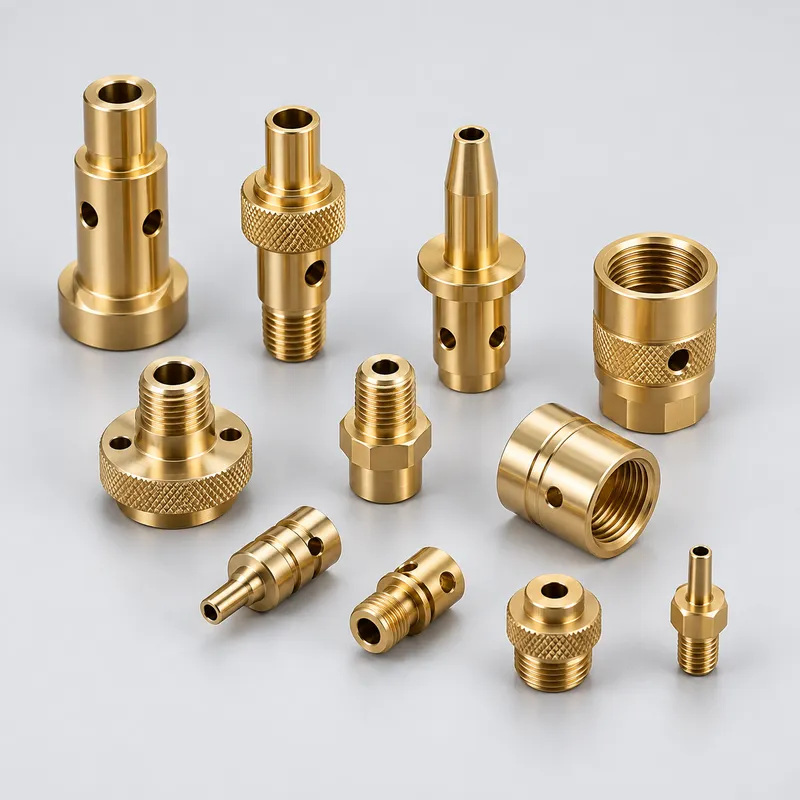
1. Stepped Brass Shaft with External Thread
The stepped shaft combines functional diameters, a shoulder, an axial bore and an external thread. Its performance depends on the relationship between these features, not simply their individual sizes.
The shaft is turned from one bar setup wherever the geometry allows. This keeps the bore, outside diameter, shoulder and thread referenced to the same spindle axis. Reducing re-clamping helps limit accumulated runout when the shaft rotates or locates another component.
2. Female-Threaded Brass Sleeve
The sleeve includes a bore, internal thread, outside steps and, on selected versions, a knurled band or cross-drilled hole. The internal thread must engage smoothly while the sleeve remains stable during machining.
We establish the bore and internal thread from the turned datum before completing the external profile. Inspection may use thread gauges or approved mating samples. Thread entry, burr removal and bore cleanliness are checked because small chips can interfere with assembly.
3. Turn-Milled Brass Fitting with Cross Holes
These components combine turned diameters with side holes, milled flats or other off-axis details. Producing them on separate machines requires re-fixturing and alignment, adding another opportunity for angular error, position shift or concentricity loss.
Where the geometry permits, turn-mill machining completes the main diameter, axial hole, thread and side features in one coordinated cycle. The main benefit is preserving their relationship while reducing handling and datum changes.
Why Turn-Mill Machining Matters for Multi-Feature Parts
A conventional lathe is efficient for round profiles, grooves, bores and threads. However, a part may also require a transverse hole, wrench flat or precisely oriented feature. Moving it to a second machine adds setup time and requires a new reference.
For suitable designs, our custom turn-mill machining service combines turning and driven-tool operations in fewer setups. Practical advantages include:
Better control of concentric relationships between turned diameters and bores
More reliable position between cross holes and axial features
Less work-in-process handling during batch production
Lower risk of mixed orientations or setup-related variation
More efficient production of complete brass hardware families
Not every component needs turn-mill machining. Simple threaded sleeves may run more efficiently on a CNC lathe, while parts with off-axis details benefit from combined operations. We select the process for each design rather than forcing every part onto the same machine type.
Keeping 1,000 Sets Consistent
For a multi-part order, individual dimensions are only one part of quality control; the components must remain compatible across the batch. We identify functional datums, mating diameters, thread specifications and concentricity requirements during drawing review. First-off parts are checked before full production, while selected dimensions are monitored so tool wear can be corrected early.
The inspection focus varies by component:
Shafts: stepped diameters, shoulder positions, bore alignment and external threads
Sleeves: internal diameter, internal thread, wall condition and mating fit
Turn-milled fittings: cross-hole location, feature orientation and relationship to the turned axis
Where mating parts or approved samples are available, fit checks can be included before packing. Components can also be packed by set to reduce sorting at the assembly line.
Why Source the Complete Brass Hardware Set from One Supplier?
YS Rapid manages custom brass parts as a coordinated machinery project rather than a collection of unrelated turned items. Our scope can include drawing review, process selection, internal and external threads, cross holes, knurling, mating-feature inspection and set-based packing.
For the buyer, this means fewer supplier handoffs, one production schedule, one quality contact and one shipment for the related components. It also makes responsibility clearer if a fit issue appears during assembly.
Request a Quote for Custom Brass Turn-Mill Parts
Send YS Rapid your 2D drawings, 3D files, brass grade, quantity and assembly requirements. Mark critical concentricity, thread fit or feature orientation on the drawing, and include mating-part information when available. We will review which components suit CNC turning and which should use turn-mill machining, then return a practical manufacturing proposal and quotation.
 EN
EN
 jp
jp  ko
ko  fr
fr  de
de  es
es  it
it  pt
pt  tr
tr  ar
ar  iw
iw