More Than a Round Machined Plate
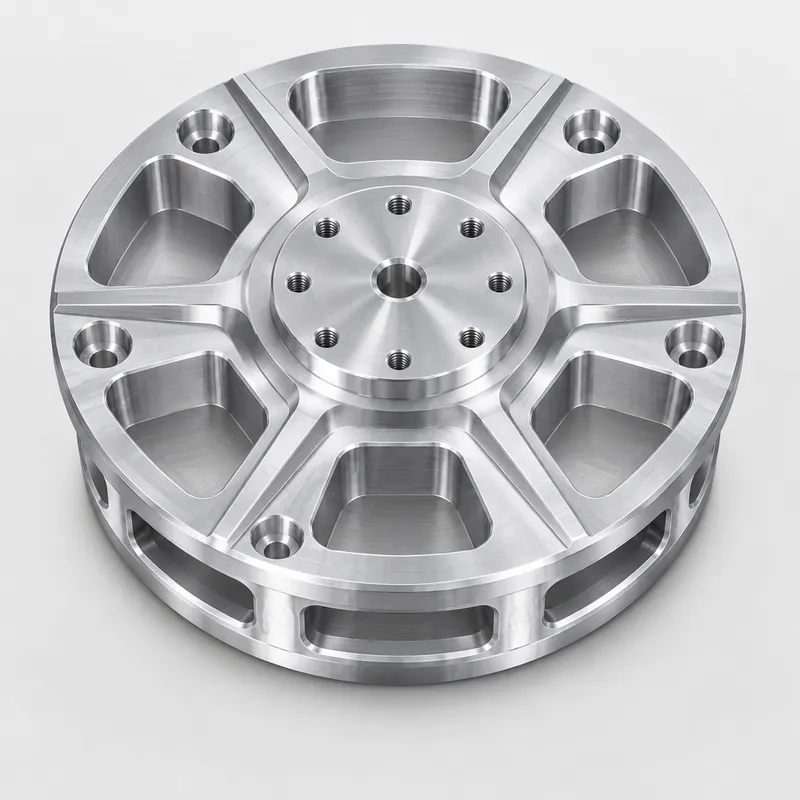
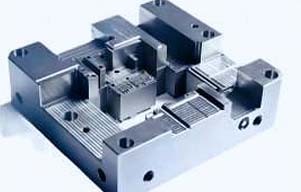
The component combines a raised central section, circular mounting positions, open pockets and machined features around the outer body. The pockets reduce unnecessary weight, while the remaining ribs provide support between the center and perimeter.
These features create several manufacturing considerations:
· The central bore establishes the primary rotational reference.
· The surrounding mounting holes must remain correctly positioned around that center.
· Large pockets reduce the stiffness of the workpiece during machining.
· Side features require access from different directions.
· Intersecting holes and openings need careful deburring.
For an automation component like this, the relationship between features is often more important than any single dimension. The machining plan therefore has to consider how the plate will rotate, mount and interact with the rest of the assembly.
Machining the Part Without Losing Stability
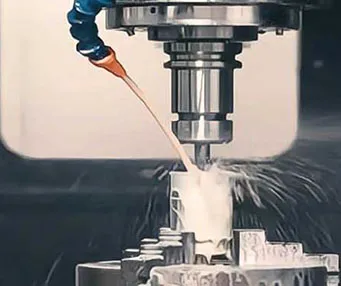
The plate was not machined to its final shape in one aggressive operation. Material was removed in a controlled sequence so that the workpiece retained enough support during roughing and finishing.
The main pockets were roughed first while additional material remained around structurally sensitive areas. The central section, radial profiles and outer geometry were then finished progressively. Critical holes and mounting features were completed after stable reference surfaces had been established.
This balanced approach helped reduce local movement as the plate became lighter and more open. It was especially important across a 16-piece batch, where the customer needed consistent components rather than one acceptable sample followed by variable parts.
Five-axis machining also improved access to the side openings and multi-directional features. Fewer manual repositioning operations meant fewer opportunities for setup-related deviation.
Why Aluminum 6061 Was Suitable
Aluminum 6061 is widely used for fixtures, machine structures and prototype automation parts. It offers a useful balance of strength, weight and machinability.
For this rotary plate, the material provided:
· Lower weight than an equivalent steel component
· Good machinability for deep pockets and detailed profiles
· Sufficient strength for many structural fixture applications
· Good dimensional stability under a planned cutting sequence
· Compatibility with anodizing and other surface treatments if required
Its machining characteristics also make it suitable for projects that may need design revisions after assembly testing.
From Prototype Verification to a Small Batch
A requirement for 16 parts usually indicates that a project has moved beyond a single concept sample. The components may be needed for several prototype machines, an initial equipment build or functional testing under working conditions.
CNC machining allows this quantity to be produced without investing in dedicated tooling. If the customer identifies an assembly issue, the CAD model and machining program can be revised before the next production stage.
This makes five-axis prototype machining suitable for complex automation parts that need real material properties and production-representative geometry.
Inspection Around the Functional Reference
Inspection of a rotary fixture plate should not be limited to measuring hole diameters independently. The center, hole pattern and surrounding geometry need to be evaluated as a connected system.
The main inspection points for this type of component include:
· Overall diameter and plate thickness
· Central bore and raised mounting section
· Position of the circular mounting pattern
· Pocket depth and profile
· Side openings and threaded features
· Edge condition and burr removal
· Visual consistency across the batch
The completed components were cleaned and protected before shipment.
Custom Five-Axis Machining for Automation Parts
YS Rapid supports prototype development and small-batch production for rotary plates, equipment housings, brackets, fixtures and other complex metal components. Our team works from customer-supplied 3D files and 2D drawings, reviewing machining access, reference features and assembly requirements before production.
If you are developing an aluminum fixture plate or another multi-face automation component, send us your CAD data, material requirement, quantity and critical dimensions. We can review the project and recommend a practical machining approach.
 EN
EN
 jp
jp  ko
ko  fr
fr  de
de  es
es  it
it  pt
pt  tr
tr  ar
ar  iw
iw