Producing a Family of Parts at 200 Pieces Each
This was not a mixed quantity shared across several designs. The customer needed 200 units of every specified component so the hardware could support a defined number of equipment assemblies. A shortage in just one part number would leave otherwise complete machines waiting for a low-value item.
We planned the order by part number and maintained separate production, inspection and counting records for each design. First-off pieces were checked before the remaining batch was released. During production, selected dimensions were monitored to identify changes caused by tool wear or swarf buildup. This approach is practical for low-volume turned parts: it protects batch consistency without adding unnecessary inspection to every non-functional surface.
Threaded Features Made for Assembly
Several components required tapped holes or machined threads. For these features, nominal thread size alone was not enough. Pilot-hole diameter, usable depth, entry chamfer and burr condition all affected whether the customer could install the hardware smoothly.
After machining, threads were cleaned and checked using the appropriate method for the drawing requirement. Particular attention was given to blind tapped holes, where chips left at the bottom can reduce effective engagement. Edges at the thread entrance were finished carefully to support easier starting while preserving the required engagement length.
Knurling as a Functional Feature
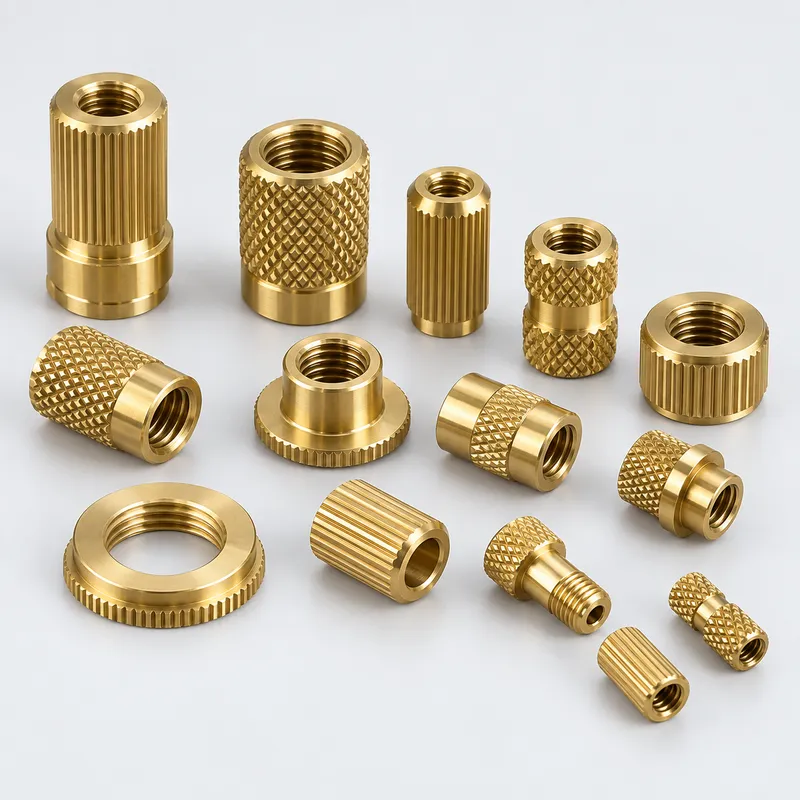
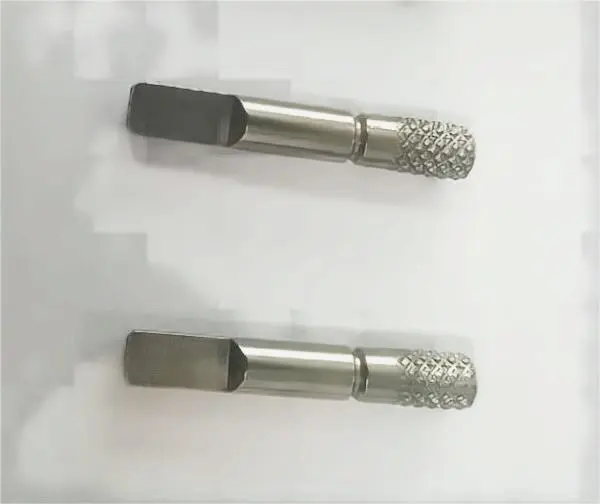
The straight and diamond-knurled surfaces shown on these brass parts are not simply cosmetic. Depending on the assembly, a knurl may provide hand grip, resist rotation or create retention when a component is pressed into a mating part.
Knurling displaces material and changes the effective outside diameter. For that reason, we considered the specified fit and function when selecting and controlling the knurling operation. Pattern quality, coverage, diameter and edge condition were checked on initial samples before the full run continued. Consistent knurls help reduce variation in insertion force and holding performance across the equipment build.
Inspection Around the Installation Interface
Inspection concentrated on the features that connect the hardware to the surrounding assembly:
Outside diameters used for location or press fitting
Internal and external thread condition
Shoulder positions and flange thicknesses
Overall length and stepped diameters
Knurled outside diameter and pattern consistency
Chamfers and edges that affect insertion
Where matching parts or fit requirements were supplied, relevant interfaces could also be checked before shipment. The objective was not only to confirm that the pieces matched their drawings, but to reduce avoidable interruption when the customer started installing 200 sets.
Counted and Packed by Part Number
Small turned components can be difficult to distinguish once several similar sizes are placed together. We kept each design separated, verified its quantity and labeled the packaging by part number. Threads and knurled surfaces were protected against contact damage during transport.
This packing method gives the receiving team a clearer handover. Parts can be issued to the assembly area by equipment set or by production batch, with less time spent recounting and sorting visually similar hardware.
Custom Brass Turning from Samples to Repeat Batches
YS Rapid provides custom brass turning services for prototypes and low-volume requirements. Typical products include threaded inserts, sleeves, bushings, pins, spacers, connectors and non-standard fastening hardware. Depending on the drawing, production can include CNC turning, drilling, tapping, threading, knurling, deburring and dimensional inspection.
The same project may later require a design revision, an additional part number or a repeat batch. Keeping the manufacturing and inspection requirements organized by drawing revision helps customers move from equipment validation to ongoing low-volume production without losing control of small but essential components.
For a quotation, send the 3D files, dimensioned 2D drawings, brass grade, required quantity and any fit or thread requirements. If several items belong to one automation assembly, include the part-number list and required pieces per set so we can plan production and delivery accordingly.
 EN
EN
 jp
jp  ko
ko  fr
fr  de
de  es
es  it
it  pt
pt  tr
tr  ar
ar  iw
iw