Specifications of Questions the Prototype Batch Needed to Answer
This custom machining project was planned around the customer’s verification work.
Engineering question | Feature involved | What the samples can reveal |
Does the bracket align with the surrounding structure? | Outer profile, base and mounting-hole pattern | Whether the part enters the assembly and locates without forcing |
Do fasteners sit at the intended height? | Stepped recesses and counterbores | Head clearance, seating and access for assembly tools |
Is the supported component held at the correct level? | Two raised support sections | Contact, stability and installed height |
Is side access practical inside the device? | Lateral openings | Clearance for pins, screws, cables or adjacent hardware |
Can the same result be reproduced across several builds? | Complete 10-piece batch | Variation in fit and fastening from sample to sample |
This verification-led approach gives the customer more useful information than checking the bracket only as a standalone part.
What the Bracket Geometry Tells Us
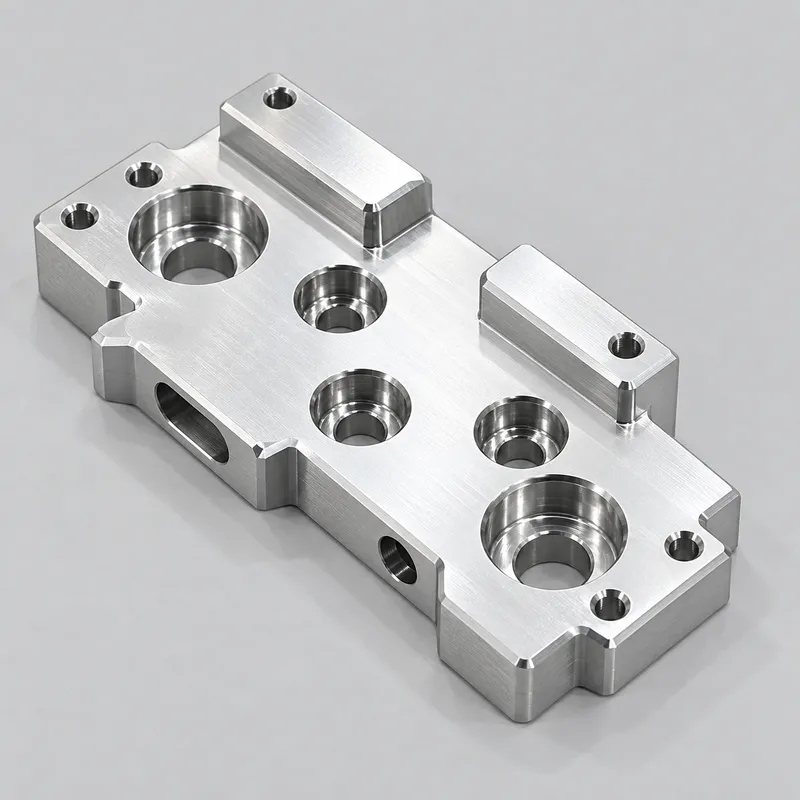
The part has a compact, plate-like body, but its top and side features make it more involved than a flat mounting plate.
Several stepped circular recesses are distributed across the main surface. These provide controlled seats for fasteners or mating elements. Their depths affect how hardware sits, while their positions influence whether the assembly can be installed without force.
Two separated raised sections create contact areas above the main plane. Their shoulders must be clean so adjoining components do not rest on burrs or uneven edges. Smaller end holes add attachment points, while side openings require another machining orientation.
Together, these details create three distinct interface levels: the base of the bracket, the recessed seats and the raised supports. The useful part is the relationship between these levels—not any one dimension viewed in isolation.
Stainless Steel Changes the Machining Strategy
Stainless steel provides strength and a durable surface, but it does not machine like aluminum. Heat remains near the cutting zone, and a rubbing tool can harden the surface locally. Deep recesses and interrupted edges may also accelerate tool wear.
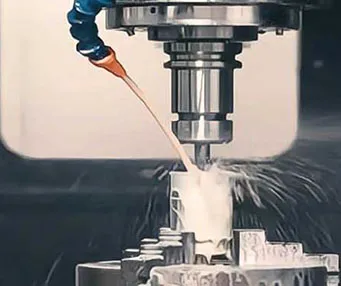
The stepped bores, shoulder transitions and side-entry features required positive cutting conditions, suitable tools and coolant. The sequence also had to retain support around the raised sections while surrounding material was removed.
A burr inside a counterbore can prevent full fastener seating. One at a side-hole exit may be difficult to see but can interfere with inserted hardware. Deburring therefore focused on functional edges without altering contact surfaces.
Releasing a 10-Piece Prototype Batch
Ten samples sit between a one-off prototype and a regular production run: workholding must be repeatable, while the design may still change after evaluation.
The first bracket was used to confirm feature interpretation and the inspection route. The same setup logic was then retained for the remaining parts. Checks covered bore seating, relative hole locations, support heights and side openings, making the batch suitable for comparative assembly testing rather than producing ten parts that only looked alike.
Custom Stainless Steel CNC Machining Without Production Tooling
For 10 development parts, CNC machining provides a direct route from revised CAD data to functional metal components. Hole positions, support heights or clearances can be updated without modifying molds or stamping tools.
YS RAPID provides stainless steel CNC machining services for medical equipment brackets, instrument frames, mounting plates and other non-implant mechanical components. Our work can include milling, drilling, tapping, reaming, multi-face machining, deburring and drawing-based inspection according to the part requirements.
Information Needed for a Similar Medical Bracket
To evaluate a custom bracket, we need more than its outside shape. The most useful quotation package identifies:
· The stainless steel grade
· 3D CAD data with a matching 2D drawing
· Functional contact surfaces
· Hole fits, thread details and counterbore depths
· Critical geometric tolerances and drawing datums
· Edge-breaking, finish and cleaning requirements
· Required inspection documents
· Sample quantity and required delivery date
When these details are clear, our team can propose a practical custom CNC machining service based on how the bracket will be tested and assembled.
Build the Bracket for the Test, Not Just the Photograph
A useful medical device prototype bracket should give the engineering team confidence about fastening, support and access inside the assembly. For this project, the 10 stainless steel samples provided a realistic basis for evaluating those points before the customer committed to a later production route.
If you need a prototype custom machining service for stainless steel medical equipment parts, send YS RAPID the design files and explain what the samples need to prove. We will review the manufacturing risks, confirm the open technical points and quote the parts around their intended verification work.
 EN
EN
 jp
jp  ko
ko  fr
fr  de
de  es
es  it
it  pt
pt  tr
tr  ar
ar  iw
iw