Why Could the Part Not Be Made by Cutting and Bending Alone?
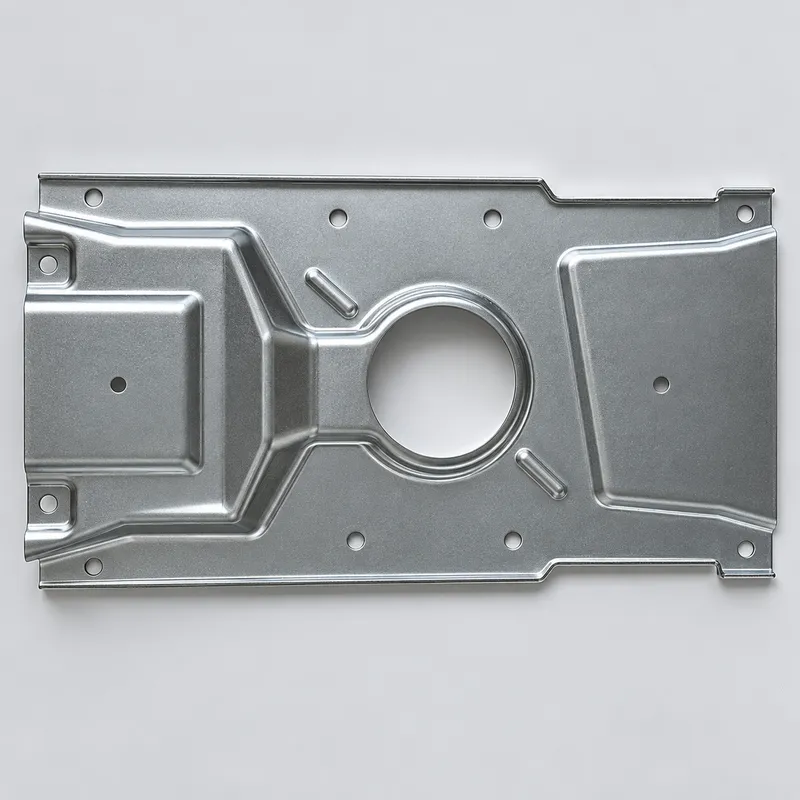
Laser cutting can produce the external profile and holes, while CNC bending can form the edge flanges. However, the raised areas in this part required controlled press forming.
These embossed features perform several possible functions:
· Increase the stiffness of the sheet metal panel
· Provide clearance for internal components
· Reinforce the area around the central opening
· Create positioning or assembly features
· Reduce deformation without using thicker material
Producing a flat approximation would not give the customer a reliable result during assembly testing. The prototype therefore needed to include the actual embossed geometry.
Simple Tooling for a Five-Piece Order
A complete stamping die is normally justified by repeat production. For five prototype parts, it would add excessive cost and preparation time.
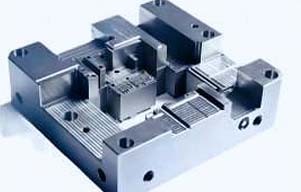
YS RAPID used a simple male and female embossing tool designed around the required formed features. This tooling method was sufficient for prototype verification while remaining more economical than a production die.
Before making the tool, we reviewed:
· Material thickness and forming direction
· Emboss height and draft
· Inside radii around the formed areas
· Distance between holes and embossed features
· Risk of cracking, thinning or wrinkling
· Expected springback
· Flatness after forming
· Clearance needed for assembly
The forming sequence was also important. Some holes could be produced in the flat sheet, while features affected by material movement had to be completed or checked after embossing.
Manufacturing Process
The five sheet metal prototypes were produced through the following process:
1. Cut the flat profiles and main openings from cold-rolled steel.
2. Form the raised sections using the simple embossing die.
3. Bend the edge flanges and remaining features.
4. Deburr the cut edges and holes.
5. Inspect the emboss profiles, hole locations and overall flatness.
6. Apply white zinc plating.
7. Complete final dimensional and visual inspection.
Large embossed areas can pull or distort the surrounding sheet. We therefore checked the relationship between the formed sections, central opening and mounting holes rather than inspecting each feature separately.
Why Use White Zinc Plating?
Cold-rolled steel has good formability and is commonly used for appliance brackets, frames and internal panels. Because untreated steel can rust, the customer specified white zinc plating.
The zinc coating provides basic corrosion protection and gives the part a clean silver-colored finish. It is well suited to internal appliance components that require practical protection without a thick painted coating.
What Could the Engineer Verify?
The five finished parts allowed the customer to evaluate:
· Mounting-hole alignment
· Fit with adjacent components
· Emboss height and location
· Clearance around the central opening
· Panel stiffness
· Flatness after forming
· Assembly accessibility
· Suitability of the zinc-plated finish
If the formed features caused interference or distortion, the design could still be adjusted before production tooling was ordered.
Low-Volume Sheet Metal Prototype Services
YS RAPID supports sheet metal prototypes that require more than basic cutting and bending. Our capabilities include:
· Laser cutting and punching
· CNC bending
· Sheet metal embossing
· Raised bosses and strengthening ribs
· Formed recesses and flanges
· Tapping, countersinking and hardware insertion
· Welding and assembly
· Simple tooling for prototype quantities
· Zinc plating, painting and powder coating
The most suitable process depends on the part geometry, sheet thickness, forming depth, tolerances and expected production volume. Some shallow features may use existing or modular tooling, while deeper or product-specific embosses require a dedicated simple die.
Information Needed for a Sheet Metal Embossing Quote
To evaluate a similar project, please provide:
· 3D model
· 2D drawing with critical dimensions
· Material and sheet thickness
· Required quantity
· Emboss height or section details
· Surface finish
· Assembly requirements
· Expected future production volume
YS RAPID can review the forming requirements, identify possible distortion risks and recommend whether simple prototype tooling or production tooling is more appropriate for your project.
 EN
EN
 jp
jp  ko
ko  fr
fr  de
de  es
es  it
it  pt
pt  tr
tr  ar
ar  iw
iw