CNC Machining Around the Housing’s Assembly Features
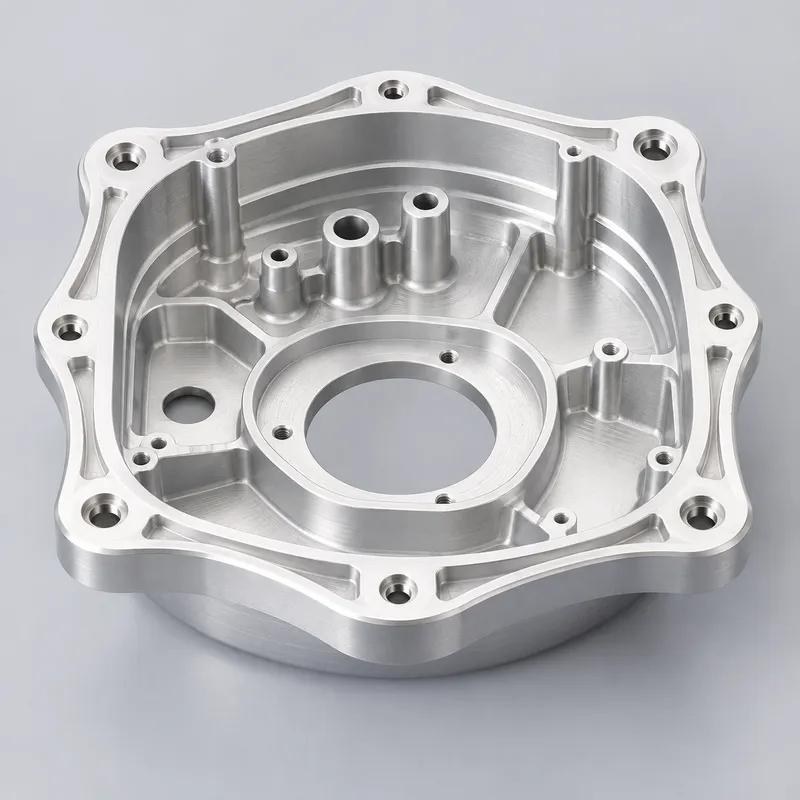
The wide central opening and stepped seat form the main interface for the rotary assembly. Several bosses of different heights provide mounting positions for internal parts, while ribs link the load-bearing areas and add stiffness without making the housing unnecessarily heavy.
The perimeter also has multiple fastening points for a mating cover or adjacent assembly. Because the center seat, bosses and outer mounting face all influence assembly, we planned the machining around common datums. This was more important than treating every hole or pocket as a separate feature.
The housing has a relatively large amount of material removed from one side. With a part like this, machining sequence matters. Heavy roughing can release stress in the aluminum and cause slight movement before the final features are cut. We therefore left machining allowance during roughing and completed the important mounting and locating areas in later operations.
Why Five-Axis CNC Machining Suited This Housing
The internal cavity contains different levels, surrounding walls and features close to the side faces. Producing them through many separate setups would increase handling and make it harder to maintain the relationship between the central opening and the perimeter features.
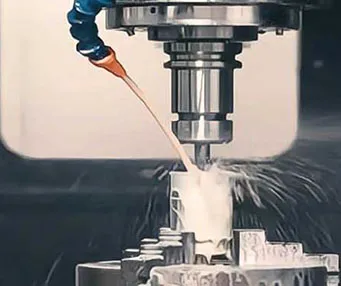
Five-axis CNC machining provided better access to these areas and reduced the need to reposition the part repeatedly. It also helped us reach the outer holes and internal features while using a consistent reference system. For a pilot batch of 30 housings, fewer setups supported both dimensional consistency and a more stable production schedule.
This does not mean every surface needs five-axis cutting. The real benefit comes from planning the complete part around efficient access, reliable workholding and fewer datum changes.
Working with 7075 Aluminum
7075 aluminum is often selected for structural components that need higher strength without the weight of steel. It is suitable for drive housings, fixtures and mechanical supports where rigidity and weight are both important.
The material machines well, but thin walls and broad pockets still need a controlled cutting strategy. Tool pressure, heat and uneven material removal can affect flatness if the part is finished too early. Balanced roughing, suitable workholding and separate finishing passes helped protect the housing geometry as the internal cavity took shape.
Moving from an Aluminum Housing Prototype to 30 Parts
One or two prototypes can confirm the basic shape of a component, but a 30-piece pilot run has a different purpose. The customer needs enough parts to build several assemblies and check whether the design performs consistently—not just whether one aluminum housing prototype fits.
For this type of low-volume CNC production, we prepare the program, workholding and inspection points with repeatability in mind. At the same time, there is no dedicated production mold or hard tooling to modify if the customer changes the design after testing.
This makes CNC machining a useful route for:
Pilot builds before production release
Engineering and assembly validation
Bridge production while a final process is being prepared
Custom industrial equipment produced in limited quantities
Inspection Based on Assembly Requirements
Inspection for this housing concentrates on the features that affect fit and movement. These typically include the central seat, mounting-face flatness, boss positions, fastening-hole locations and clearances inside the cavity. Threads, edges and machined surfaces are also checked before the parts are packed.
When customers provide mating-part drawings or an assembly model, we can review tool access, datum selection and possible interference before production. This is particularly useful during a pilot build, when feedback from machining and assembly may still lead to a design revision.
Custom Aluminum CNC Machining from Prototype to Pilot Run
YS Rapid provides custom aluminum CNC machining for housings, brackets, fixtures and other mechanical components. We support early prototypes as well as low-volume batches used for testing, customer trials and initial product builds.
Our team works from customer-supplied 3D models and 2D drawings. Before machining, we review the geometry, material, tolerances, surface requirements and assembly-related features. The goal is straightforward: manufacture parts that allow the engineering team to evaluate the design with confidence and decide what should happen next.
If you are developing a five-axis CNC aluminum housing or another complex machined component, send us your CAD files, drawings and required quantity for a DFM review and quotation.
 EN
EN
 jp
jp  ko
ko  fr
fr  de
de  es
es  it
it  pt
pt  tr
tr  ar
ar  iw
iw